


Aún no hay ninguna entrada publicada en este idioma
Una vez que se publiquen entradas, las verás aquí.
Service
Publisher:
books
10 de octubre de 2025
Businesses that require improved presentation of food would require custom food paper. The layout requires a correct design to achieve efficiency, aesthetics, and brand recognition. Efficient designs cut off wastes, cut expenses, and enhance the production process. Companies can have their food papers customized to show branding and product identity. The aspect of layout optimization affects the function and the aesthetic value. All the alignment details up to the spaces matter. It is important to learn how to pattern and write on food paper. Practical strategies that should be used when designing effective custom food paper layouts are discussed in this guide.
Harmonization of design takes proper clarity and professionalism. Balance and symmetry on the food paper are achieved with proper alignment. Companies that work with food paper bags do not have to change the distance between logos and ornamental features. Alignment also makes cutting and folding easier. Poor designs lead to printing mistakes and waste. Grid-based layouts allow the accurate placement of each element of the design. Coherent alignment removes confusion about the brand and adds value to customers.
Proper spacing results in non-cluttered content readability. Designs on food papers are made to work by leaving margins around the logos and images. Adequate distance also allows patterns not to be overcut or folded. Normally crowded shapes cause a loss of visual appeal and confusion to the observer. All sheets of food papers should be spaced evenly by the designers. The spacing can also be adjusted depending on the size of the paper to increase the efficiency of printing. Space between elements gives a more professional appearance.
Color placement provides visual and brand recognition. Effective use of colors on printed food paper emphasizes the most important aspects and also enhances readability. The color used must be in harmony with branding and also must be useful when presenting food. Text/Background Contrast gives legibility. An excess of color may bombard the design and diminish the clarity. Placing colors around areas of interest is an effective way of attracting attention. Trying the color position on the prototypes helps in avoiding mistakes in printing on a large scale.
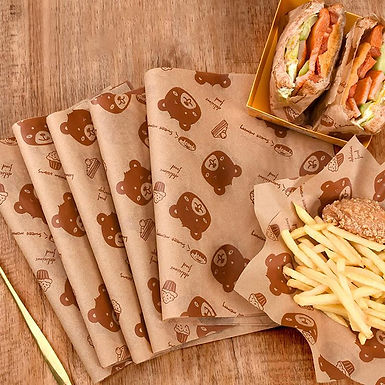
Pattern adds aesthetic value to wax food paper. Repetition of patterns brings uniformity and strengthens brand identity. The right layout makes sure patterns stack correctly on a series of sheets. The inappropriate design mismatch looks unprofessional and lowers the perceived quality. The product size should be equal to the pattern size. Pattern density affects quantities of materials consumed and costs of production. Pattern layout arrangements are well structured and make the consumer experience feel nice.
Layouts are to be used with great brand visibility. It is important to put logos where people can see them, but not clutter the design by overwhelming the food paper with the logos. The aspects of branding should not vary in any way depending on the packaging form. Placement and size of logos will enhance visual balance. When the brand elements are placed appropriately, it improves the professional appearance of the product. The advantage of the food paper roll that businesses use is that branding is done continuously along the length of the paper. Memorability and customer trust are optimized through branding layout.
Templates allow optimizing the layout on the food paper wrapper. Templates do enable designers to uphold uniformity, spacing, and pattern. Guides are predefined to minimize errors in printing and the cutting process. It is possible to modify the templates according to paper sizes and the type of products. Templates make the process quicker and more consistent between production batches. Template frameworks can help designers experiment with layouts. They reduce efficiency and quality of production and presentation of products through proper templates.
Before deciding to print on a large scale, a testing layout will avoid an expensive error. Mockups can be used to test the design consistency of food paper bags and other paper materials. Testing is used to determine spacing, color placement, pattern accuracy, and branding effect. These changes can be made according to the prototype. Workflow testing minimizes the waste of material and errors in printing. Repeated adjustments are made to final layouts to satisfy design requirements. Testing provides the quality of custom food that improves brand and presentation.
Durability and usability can be guaranteed by selecting the appropriate material. Folding, printing, and the general appearance of food wrap depend on the texture and thickness of the food wrap used. Incidents of tearing during paper handling can be avoided by choosing good-quality paper, and the print will always be the same. Grease resistance and moisture protection are also affected by the material. Various types of papers will have varying printing methods, where they will be best seen. Assessment of the material performance of the Wax wrapping papers prior to mass production minimises errors. A good choice of materials increases the functionality of the product and customer satisfaction.
Good printing methods enhance graphics and logo communication. Printing with offset or digital printing gives sharp, quality images of food printed on paper. Correct printer settings will eliminate smudging and ensure color accuracy. Aligned problems with prototypes are prevented through repeated tests. Wax food paper can be spruced up with specialty inks that improve contrast so it can be read. The ability to print across batches makes the brand stronger. Waste is minimized by efficient printing, and production is made more efficient. The correct technique is selected to make the photo as beautiful and long-lasting as possible.
Layouts of custom food paper are highly important when it comes to efficiency and brand impact. Correct alignment, spacing, and color positioning enhance readability and beauty. Branding elements and patterns must be placed in a position of the greatest influence. Templates also make the design process easier and consistent. The result is a testing workflow that makes work accurate and waste-free. It saves businesses 'expenses and stops amateurish presentations. Each bit of layout optimization is a quality detail contributed to the product. These strategies will help in coming up with attractive and practical custom packaging.
Classics
Vibnet Blog Posts: