


Aún no hay ninguna entrada publicada en este idioma
Una vez que se publiquen entradas, las verás aquí.
NEWS
Publisher:
advisorwheels
6 de octubre de 2025
According to the Environmental Protection Agency (EPA), transportation is a significant source of greenhouse gas emissions, with almost 30 percent of the carbon dioxide emissions worldwide being caused by transportation. In light of the current climate change crisis, vehicles that we use are critical in determining a sustainable future. Making environmentally friendly choices in transportation is not only a matter of reducing emissions but also making rational and economically effective decisions that meet the current way of life. This article discusses the ways you can make smarter transportation decisions to reduce your carbon footprint, with vehicles such as the Tesla Model Y being the first step in that direction.
Your carbon footprint is the total amount of greenhouse gases, which is mostly carbon dioxide, of your activities. This applies to transportation where you can include driving, fueling, and servicing your car. An average gasoline-powered car produces an estimated 4.6 metric tons of CO2 each year, according to EPA estimates of average driving patterns (12,000 miles/per year).
Gas powered cars are dependent on fossil fuels which emit CO2, nitrogen oxides and other emissions that pollute the air and contribute to global warming. In addition to environmental effects, motorists are exposed to increased fuel prices, with gas prices in the U.S. topping an average of 3.50 per gallon in 2025, 20 percent higher than they were a decade earlier. By redefining transportation you can reduce your environmental cost as well as your costs in the long run.
The U.S. Department of Energy says that internal combustion engine vehicles are inefficient, and only 2030 percent of fuel energy is spent on movement. The remainder is swept away by heat and friction, resulting in high emissions, approximately 400 grams of CO 2 per mile per a normal SUV. Such dependence on non-renewable fossil fuels drains resources and contributes to global warming.
Gas cars are associated with increasing prices: the price of gasoline is fluctuating, and repair (oil change, engine repairs) are not free. The traditional SUVs have been very popular in their space but in reality they lack the efficiency that they require in the current economic and environmental conditions. These expenses and inefficiency are more attractive to greener alternatives in families or those who drive frequently. For more information visit AdvisorWheels.
Zero tailpipe emissions are achieved by electric vehicles and significantly reduce your carbon footprint. The development of battery technology has increased the range of many EVs to more than 300 miles per charge, and it can now be used to commute to work and travel. The electricity that is used by EVs is also renewable, which further lowers its environmental impact.
Hybrids are gas and electric-powered vehicles, which are more fuel-efficient (e.g., 4050 MPG) than conventional cars. PHEVs can make short electric-only journeys but still use gas on longer routes. Although they are practical in terms of transitioning, they cannot be compared to zero-emission benefits of full EVs.
Motor vehicles, carpooling, and bikes are also suitable to the short-distance urban trips, and emissions are lower by 80 percent than in case of individual driving, according to the EPA. Nevertheless, EVs can be a better solution as it is not universal and can be adapted to the needs of rural inhabitants, families, or people who should be flexible.
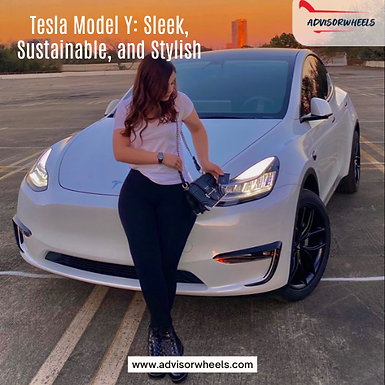
Tesla Model Y is the fully electric crossover/vehicle that provides a solid solution to the eco-conscious drivers. It has a maximum range of up to 326 miles (EPA-estimated), which makes it easy to use on commutes, errands, and road trips. It sells competitively with gas powered SUVs at its initial price of approximately $44,990 including federal tax credits up to 7,500 dollars. The electric prices are cheaper than gas, so a full charge of a Model Y at home is estimated to be $15 versus $50-60 to refill a gas SUV tank.
Such capabilities as Autopilot to semi-autonomous driving and automatic updates of the software, which make the Model Y advanced, contribute to efficiency and safety. The fast charging (up to 200 miles in 15 minutes) is offered by Tesla Supercharger network that operates partly on solar energy. Depending on the average driving statistics, it would require switching to a Model Y to save around 4 tons of CO2 every year in comparison with a gas SUV.
For a family of four, the Model Y offers ample cargo space (68 cubic feet) and seating, blending practicality with sustainability. Its all-wheel-drive option ensures performance in diverse conditions, from city streets to snowy highways, making it a versatile choice for reducing emissions without compromising lifestyle.
Review your driving: How many miles do you drive every day? Also, do you require family or gear space? The Tesla Model Y is efficient across several demands and its range and crossover styling are the most appropriate to be taken on a decent adventure and its range by far is so long that it can make it to any destination that is within the city or even to a lounge, family members, etc.
Home charging is convenient and cost-effective—installing a Level 2 charger costs $500–$1,500 and charges the Model Y overnight. Tesla’s Supercharger network, with over 2,000 stations in the U.S., ensures reliable public charging. Range anxiety is minimal, as most daily trips (under 40 miles, per the U.S. Department of Transportation) are well within EV capabilities.
EV tax credits (up to $7,500 on the federal level) and state rebates (such as Clean Vehicle Rebate in California, 2,000 dollars) reduce initial costs. The EV model Y may save over 1000 to 2000 a year in fuel and maintenance, according to Consumer Reports. Local incentives Research local incentives can be found in dsireusa.org to maximize saving.
While EVs have higher sticker prices, tax credits and lower operating costs (e.g., $0.03–$0.05 per mile vs. $0.15 for gas cars) make them cost-competitive over time. The Model Y’s total cost of ownership is often lower than gas SUVs after 5 years.
Charging networks are sweeping fast-communication networks- there are now more than 70,000 public charging stations in the U.S. alone, according to the Department of Energy. Most of the requirements are taken care of by home charging, and Tesla Superchargers are the solution to hassle-free long-distance travel. Visit New Model Y L Unveiled: What’s New for 2025?
Myths about EVs (e.g., limited range or performance) are outdated. The Model Y’s 0–60 mph in 4.8 seconds and 326-mile range rival gas vehicles, while its spacious design fits families, commuters, and adventurers alike.
It is possible to cut your carbon footprint by transportation and the Tesla Model Y is one of the solutions that is modern and feasible. An EV will allow you to reduce emissions, use less fuel, and experience the latest technological innovation without affecting your convenience. Begin with an evaluation of your driving requirements, charging possibilities and local incentives. Drive a Tesla Model Y or go to tesla.com to discover how a small change can lead to a large impact to a greener future.
Mysteries, Historical Fiction, Memoirs
Vibnet Blog Posts: